If you are an Indian student preparing for an Irish Master’s, Bachelor’s, or PhD intake in 2026, this is the document you bookmark and return to until your visa sticker is in your passport. We have compiled every document, deadline, fund requirement, and edge case our counsellors have seen across 11+ years of placing students at Irish universities — built around the actual rules of the Irish Embassy and Department of Justice, updated for 2026.
Note: This is a practical guide compiled from publicly available rules and 11 years of TMC visa-file experience. It is not an official Irish Embassy document — always cross-check time-sensitive figures (fees, fund minimums, processing times) at irishimmigration.ie at the moment you apply.
- Apply window: 120 days before course start. For September 2026 intake, file from 1 May 2026.
- Hard deadline: No applications accepted within 21 working days of course start.
- Funds required: Tuition fee + minimum €10,000 living expenses for 12 months.
- Tuition rule: Tuition under €12,000 → pay €6,000+. Tuition over €12,000 → pay 50%+.
- Visa fee: approx. ₹10,000 (single entry).
- Processing time: 6 weeks official; 4–10 weeks practical depending on file quality.
- Mandatory: Police Clearance Certificate (PCC) + medical insurance + 6-month bank balance proof.
- TMC’s record: 97%+ visa success rate, Enterprise Ireland Endorsed Agent since 2018.
Ireland student visa — what you are actually applying for
For most Indian Master’s and Bachelor’s students, the Ireland student visa is the “D” Study Visa — a long-stay entry permit that allows you to enter Ireland for the purpose of full-time education. Once you arrive, you separately register with the Irish Naturalisation and Immigration Service (INIS) to receive your Stamp 2 residence permit — the actual document that lets you live and study legally in Ireland for the duration of your course.
The “D” visa is what the Indian Embassy of Ireland processes from New Delhi. The Stamp 2 is what you collect once you land. Most Indian students confuse the two — they are sequential, not alternatives.
The single most common mistake we see is students treating “visa approved” as the end of the process. It is the start. Once you land, you have 90 days to register with INIS, get your IRP card, and confirm Stamp 2 — without which the visa becomes a useless piece of paper.
Application timeline — when to file
The Embassy of Ireland accepts visa applications 120 days before your course start date. For September 2026 intakes, that means the visa filing window opens around 1 May 2026. We strongly recommend filing in the first 4 weeks of that window.
| Course start | Visa window opens | Recommended filing | Hard deadline (21 working days before) |
|---|---|---|---|
| September 2026 | ~1 May 2026 | May–June 2026 | ~early August 2026 |
| January 2027 | ~1 September 2026 | September–October 2026 | ~early December 2026 |
Important: Applications submitted within 21 working days of your course start date will be returned without processing. Even if accepted by the visa office, last-minute files are far more likely to be refused than ones filed in the first 4–6 weeks.
The complete document checklist
Documents are grouped into 6 categories. Bring originals plus one self-attested photocopy of each. The visa office keeps the photocopies; your originals go into your passport pouch.
1. Personal documents
- Original passport (current) + all previous passports
- Passport validity must cover full course duration plus at least 6 months
- Minimum 4 continuous blank pages in current passport
- Visa application fee — approximately ₹10,000 (single entry, subject to revision)
- Two recent visa-format photographs (35×45mm, white background, Irish specifications)
- Marriage certificate (if applicable)
- Children’s birth certificates (if applicable)
- Name-mismatch affidavit (if any spelling/sequence variation across documents)
2. Educational documents
- 10th Standard certificate + marksheet
- 12th Standard certificate + marksheet
- All semester-wise Bachelor’s marksheets
- Bachelor’s degree certificate (or provisional certificate if degree not yet issued)
- Master’s / PhD certificates (if applicable)
- Consolidated transcript (if available)
- Internship certificates (if any)
- English language test score: IELTS 6.0+ overall (no band below 5.5), or TOEFL 80+, or PTE 63+, or Duolingo 110+ — confirm the specific requirement of your offer letter
- Gap-year explanation letter (mandatory if academic gap exceeds 12 months)
- Updated CV/resume — signed and dated by you
- Previous visa refusal letters from any country (if applicable, full disclosure required)
3. Work experience documents (if applicable)
- Work experience letters from all employers (on company letterhead)
- 6 months of salary account bank statements
- 3 most recent salary slips
- PF / ESI / Form 16 statements (last 2 years)
- Appointment letter or relieving letter (whichever applicable)
4. Statement of Purpose (SOP) / Personal Statement
Your SOP is read carefully by the visa officer — not just by the university. It must clearly answer:
- Background: Family, education, current professional status
- Why this programme? Specific subjects, modules, faculty research areas
- Why this university? Reputation, ranking, industry links, alumni network
- Why Ireland? Why Ireland over UK, Germany, Australia, USA
- Career outcomes: Roles, target companies, expected salary band, return-to-India strategy
- Financial plan: Who is funding, how funds are arranged, why parents/sponsor agreed
5. Documents from your university (institution)
- Unconditional offer letter (not conditional)
- Offer acceptance letter signed by you
- Tuition fee payment receipt (Swift / TransferMate / Telex)
- Letter from the university confirming minimum 50% tuition fee has been received
Tuition fee rule — the most-failed point. If your tuition is below €12,000, you must pay at least €6,000. If your tuition exceeds €12,000, you must pay at least 50% of the total fee. Visa officers verify this against the university’s letter — not your bank statement. Failure to meet this rule is the #1 documented refusal reason for Indian visa files.
Police Clearance Certificate (PCC) — mandatory
The Embassy of Ireland requires a Police Clearance Certificate from India for every applicant aged 16 and above. Apply through the Passport Seva Kendra portal online and book an appointment at your nearest centre.
If your current address matches your passport address
- Original passport
- Self-attested photocopies of first and last 2 pages of passport
If your current address differs from your passport address
- Original passport (and old passport if available)
- Proof of current address (Aadhaar, utility bill, rental agreement)
- Police verification at the new address may be required — this can take 2–4 extra weeks. Apply early.
Medical insurance — mandatory
Comprehensive medical insurance is mandatory for the full duration of your course. ODON insurance is widely accepted and most commonly used by Indian students — bought online with instant policy issuance.
No medical tests are required for the visa itself, but the policy must explicitly cover:
- Hospitalisation and outpatient care
- Repatriation of remains in case of death
- Minimum coverage of €25,000 (most policies are €30,000+)
- Validity covering the full course period
The funds requirement — what you actually need to show
This is where most refusals happen. The maths is simple but the documentation trips students up.
Total funds required = Tuition Fee + €10,000 Living Expenses
The €10,000 living expenses are the official Irish Embassy minimum for one academic year. In practice, Dublin students need closer to €13,000–€15,000 to live comfortably — but for the visa file, €10,000 is the bar.
Eligible sponsors
- Self (your own funds)
- Parents (most common)
- Spouse / In-laws
- Siblings / Grandparents
Funds from third-party non-relatives (uncles, aunts, family friends) are not accepted as visa sponsors — even if they offer a written undertaking.
Acceptable financial sources
| Source | Document required | Minimum age of funds |
|---|---|---|
| Savings account | Bank statements (last 6 months) | 6 months |
| Fixed deposits | FD certificate + balance confirmation | 6 months |
| Education loan | Sanction letter on bank letterhead, disbursement schedule | Recent (must be approved, not “in process”) |
| PF / PPF / GPF | Account statement, balance certificate | 6 months |
| LIC surrender value | LIC surrender value certificate | Policy active 3+ years |
| Mutual funds / DMAT | Latest holdings statement, valuation as of last week | 6 months |
| Property sale proceeds | Sale deed + bank credit confirmation + PAN-linked transaction trail | Funds in account 3+ months |
Unacceptable funds — visa refusal triggers
- Gold loans
- Overdraft facilities
- Chit funds / informal collective savings
- Housing loans
- FD-backed loans (where the FD itself is collateral) with less than 6 months maturity
- Large unexplained recent deposits (“parking funds” — visa officers spot this immediately)
Family funds beat education loans, every time. An education loan satisfies the maths, but a visa file backed by 6 months of stable family savings + a small loan is materially stronger than one funded entirely by a fresh loan. If your family has the savings, demonstrate them first; use the loan as a backup buffer rather than the primary source.
The 7 most common refusal reasons (and how to avoid each)
Across 11+ years of placing students at Irish universities, our counsellors have catalogued the recurring patterns in refusal letters. Avoid these and your odds materially improve:
- Insufficient tuition payment — paying €5,000 instead of the required €6,000 for a sub-€12k programme; or paying 40% instead of 50% for a €15k programme. Fix: calculate the exact minimum and pay €500 above it.
- Funds in account less than 6 months — large recent deposits with no clear source. Fix: plan funds 8–9 months before filing.
- Weak SOP / motivation letter — generic templates downloaded online, no specific programme/university research. Fix: write a fresh SOP for each university; 800 words minimum, programme-specific.
- Gap year unexplained — gap of 12+ months without a clear explanation letter and supporting evidence (work, exam preparation, family circumstances). Fix: write a 1-page gap letter with documentary evidence (employer letters, IELTS receipts, etc.).
- Previous visa refusals undisclosed — instant red flag if a UK or Schengen refusal is hidden and discovered. Fix: disclose every previous refusal (any country) with the original refusal letter and a brief context note.
- Unrealistic career narrative — claiming you will return to India without showing how the Irish degree adds to your Indian career trajectory. Fix: link the programme directly to a specific Indian industry, role, or employer-type.
- Document mismatches — your name across passport, 12th certificate, degree, and bank account is not consistent. Fix: name-mismatch affidavit + cross-reference letter.
What if your visa is refused
If your visa application is refused, do not panic. The Embassy of Ireland allows an appeal within a stated window (usually 8 weeks of refusal). The appeal is reviewed by a different visa officer.
Steps for filing an appeal
- Read the refusal letter carefully — note every concern raised by the visa officer
- Address each concern point-by-point in your appeal letter
- Include any new supporting documents that respond to those concerns
- Submit the appeal within the deadline stated in the refusal letter
- Track the appeal status via the visa office reference number
At The Mentors Circle, our visa team has filed and won more than 200 appeals in the past five years — including for students who were not originally placed by us. The success rate on a well-prepared appeal is materially higher than a fresh application would be.
Special cases — when the standard checklist needs adjustment
Students with academic gaps over 1 year
You need a written gap explanation supported by documentary evidence. If you worked: employer letters, salary slips, Form 16. If you prepared for competitive exams: admit cards, score reports. If health or family reasons: medical certificates, undertaking letter from parents.
Married applicants
Add: marriage certificate (apostilled if recent), spouse’s passport copy, spouse’s financial documents if they are co-sponsoring. If your spouse is travelling with you, they apply for a Stamp 3 dependent visa separately.
Students with prior work experience
Strong asset, but also creates extra documentation. Include all employer letters, full salary history, PF statements, and a clear explanation of why you are leaving an established career to study. Visa officers scrutinise this carefully.
Students with previous Schengen / UK / US refusals
Disclose. Always. With original refusal letters. Compose a separate explanatory letter addressing the original refusal reason and what has changed since. Hidden refusals are caught approximately 80% of the time via Embassy databases — and getting caught is an automatic refusal.
PhD applicants
Same as Master’s, plus: PhD admission letter from supervisor, research proposal abstract (1–2 pages), evidence of full funding for the research duration (typically 3–4 years).
Why TMC’s visa work is different — Enterprise Ireland Endorsed
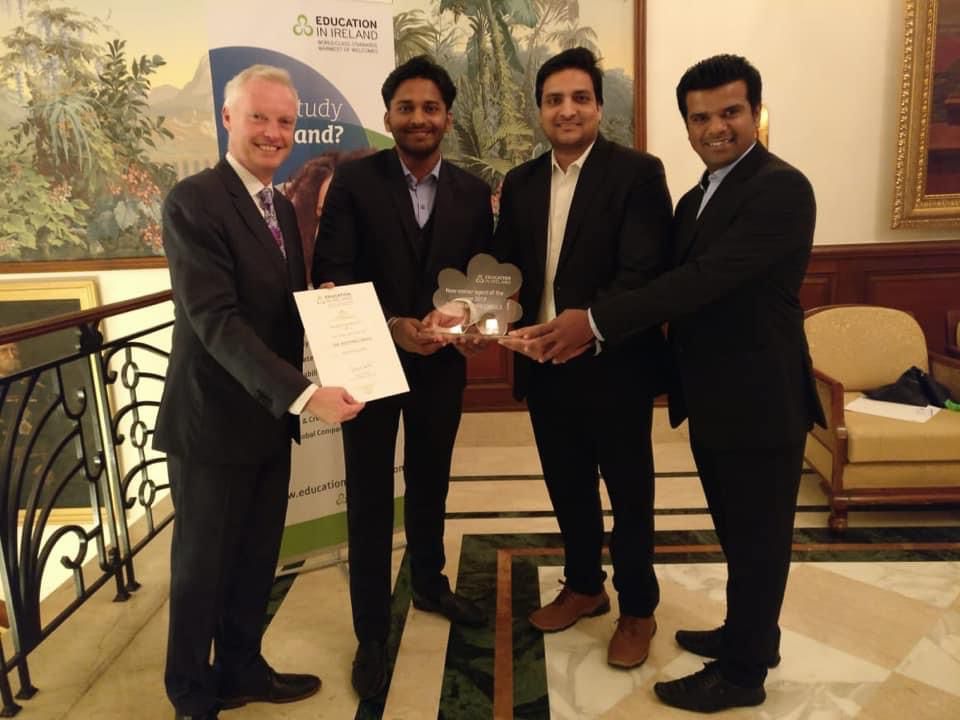
The Embassy of Ireland and Enterprise Ireland do not endorse most Indian study-abroad agents. Endorsement is reserved for a small number of agencies whose visa-file quality, approval rates, and ethical standards meet the standards set by the Irish government.
The Mentors Circle was selected as an Enterprise Ireland Endorsed Agent in 2018, presented by the Irish Minister for Education. Selection was made in consultation with the Irish Embassy on the basis of:
- Reputation across Indian student communities
- Quality of visa-file submissions across multi-year tracking
- Approval rates against industry baseline
- Compliance with Irish Department of Justice documentation standards
Since that recognition, our visa team has maintained a 97%+ approval rate across all Indian student visa files filed for Irish institutions. We have also been formally recognised by Ulster University (2026), University College Birmingham (2026), and University of Galway (2024) for the consistency of our advisory work.
If you would like to read the full picture of our Irish university partnerships, see our About page for a complete list of recognitions and the universities we work with directly.
Ireland student visa — frequently asked questions
How long does the Ireland student visa take to process?
Official processing time is around 6 weeks from the date the visa office receives your file. In practice, processing ranges from 4 to 10 weeks depending on application volume, file completeness, and whether additional documents are requested.
What is the visa fee for an Ireland student visa?
The single-entry “D” study visa fee is approximately ₹10,000. This fee is non-refundable and is paid via demand draft favouring the Embassy of Ireland. The fee is subject to revision — verify the current amount on the Embassy’s website at the moment you file.
Can I work on a Stamp 2 student visa in Ireland?
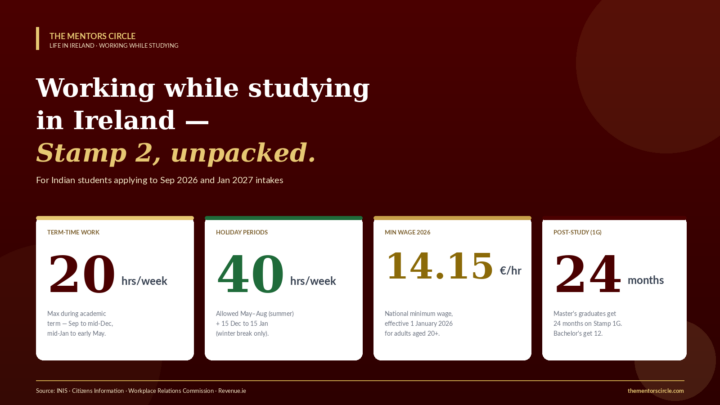
Yes. Stamp 2 holders can work 20 hours per week during academic terms and 40 hours per week during official vacation periods. You can work in any sector — there is no restriction to “student-only” jobs.
Do I need IELTS for the Ireland student visa?
The visa office does not require IELTS directly, but your Irish university requires it as part of admission. Once you have an IELTS/TOEFL/PTE/Duolingo score, that score is included in your visa file as part of the educational documents pack.
Is GMAT or GRE required for an Ireland student visa?
No. GMAT/GRE are sometimes required by individual MBA or Master’s programmes (typically Trinity Smurfit MBA), but they are not required by the visa office.
Can my education loan be used as the only fund proof?
Yes, technically — but it is materially weaker than a combination of family funds + loan. Pure-loan-funded files have a higher refusal rate than mixed-source files. We recommend showing 60–70% family funds and 30–40% loan if possible.
What is the Stamp 1G post-study work visa?
After completing your Master’s, you become eligible for a 2-year Stamp 1G post-study work permit — full-time work rights at any Irish employer with no sponsorship requirement. After Stamp 1G, you can transition to a Critical Skills Employment Permit, which sets you on a 2-year path to Irish Permanent Residency.
Can I bring my family to Ireland on a student visa?
Spouses and dependent children can apply for Stamp 3 dependent visas, applied separately. Stamp 3 holders cannot work in Ireland during your study period — they can join you and remain, but employment rights only kick in if the primary student transitions to Stamp 1 or Stamp 4.
How long is my Ireland student visa valid?
The “D” visa allows entry into Ireland; once registered with INIS, your Stamp 2 is valid for the duration of your course (typically 1 year per registration, renewable for the full programme length). You must renew Stamp 2 annually.
What happens if I cannot show €10,000 in funds?
The €10,000 living expenses minimum is non-negotiable for visa approval. If you cannot demonstrate this, your visa will be refused. Options: top up via family fund transfer (kept in account 6+ months), supplement with education loan, or defer your intake to next year and build the fund balance.
Can I apply for the visa if I have a previous UK refusal?
Yes. Disclose the previous refusal with the original refusal letter, write an explanatory letter addressing the concerns raised in the original refusal, and submit a stronger Ireland application. Many of our students with prior UK refusals have successfully obtained Irish student visas.
Do I need to attend a visa interview at the Embassy?
For most applications, no in-person interview is required. The Embassy reviews your file and issues a decision based on the documents submitted. In rare cases, the visa office may call you for a clarifying interview — this is not a refusal indicator, just a verification step.
What is INIS and when do I register?
INIS is the Irish Naturalisation and Immigration Service. After arriving in Ireland, you have 90 days to register at the local INIS office (Burgh Quay, Dublin, or your regional office), submit your biometrics, and receive your Irish Residence Permit (IRP) card — the physical proof of your Stamp 2 residence permit.
Can I switch universities after arriving in Ireland?
Yes, but only between INIS-approved Irish institutions, and only with proper notification to INIS. Switching from a non-approved institution voids your Stamp 2.
What if my course start date is delayed by the university?
Notify the Irish Embassy immediately with the university’s official communication. The visa office can accommodate course-date changes if notified in advance. Do not arrive and try to explain — the airport authorities will refer you to immigration.
Final checklist — the day before you submit
Before you walk into the visa application centre, verify that you have:
- Your passport (current + previous) and 4 blank pages
- Visa application form printed, signed, and dated
- Visa fee in DD form
- 2 photographs (Irish-format, white background)
- Unconditional offer letter + offer acceptance + tuition payment proof
- All academic documents (10th, 12th, degree, transcripts, English test)
- SOP (signed)
- Updated CV (signed and dated)
- PCC issued from Passport Seva
- Medical insurance policy document
- 6 months bank statements (your funds + sponsor’s funds)
- FD/loan/PF/PPF documents as applicable
- Sponsor declaration + sponsor financial documents (if applicable)
- Marriage certificate / gap letter / refusal letters (if applicable)
If everything on this list is in order, your odds are strong. If any one item is incomplete, file with the missing piece flagged in a covering letter — the visa office can request clarification rather than refuse outright if you are upfront.
If your file is being prepared for an Irish institution and you would like a second pair of expert eyes, we offer free file reviews to any Indian student preparing for September 2026 or January 2027 intake. We do not charge for the review whether you are a TMC student or not.
Last updated: May 2026. Source & verification: Embassy of Ireland (New Delhi), Irish Naturalisation and Immigration Service (INIS), Department of Justice Ireland, Enterprise Ireland. Tuition rules, fund minimums, and processing times are subject to revision — verify time-sensitive figures directly with the Embassy of Ireland or your INIS-approved institution at the point of application. The Mentors Circle is an Enterprise Ireland Endorsed Agent (2018) and recognised partner of Ulster University, University College Birmingham, and University of Galway.