Ireland’s Rise as a Global Finance Powerhouse — What Indian Students Should Know

Ireland is rapidly emerging as a high-value destination for Indian students seeking careers in finance, fintech, business analytics, and technology. It offers an English-speaking environment, strong graduate outcomes in key sectors, and a post-study work route that makes it practical for international students who want real career progression in Europe.
Why Ireland is India’s Best-Kept Study Abroad Secret
Ireland combines three things Indian students care about most: English-medium education, a strong ecosystem for finance + tech, and a practical route to gain work experience after graduation. If your goal is not just “a foreign degree” but a global career trajectory, Ireland deserves serious attention.
1) Ireland: Europe’s Rising Financial Powerhouse
Ireland isn’t “small” in financial terms. It has become a global financial services base with deep presence across banking, insurance, funds, aircraft leasing, and capital markets.
- 9,000+ financial services companies
- Top global banks and major insurers operate in Ireland
- 60% of the world’s leased commercial aircraft managed through Ireland’s aircraft leasing ecosystem
- €5.2 trillion assets under administration (global funds domicile strength)
- Financial services exports have grown substantially over the last decade
For Indian students, this translates into:
🎯 internship and entry-level roles in finance operations, risk, compliance, analytics, funds, and fintech
💼 exposure to multinational teams and real European market experience
📈 a career foundation in an ecosystem built around global financial services delivery
2) Tech + FinTech Innovation Hub (Finance Meets Technology)
Ireland is a strong intersection of traditional finance and advanced technology. Dublin, in particular, attracts global tech operations and fintech growth because it is English-speaking and deeply connected to European business.
- If you add finance domain knowledge to tech/data skills, your employability improves sharply.
- Roles in data analytics, cybersecurity, cloud, payments, and product operations are common pathways.
- FinTech-adjacent career tracks often include risk analytics, fraud prevention, AML, and regulatory operations.
3) English-Speaking Advantage Inside the EU
For many Indian students, the practical advantage is simple: you can study, work, and integrate without a new language barrier. That reduces friction in academics, part-time jobs, internships, and professional life.
- Programs are taught in English
- Workplace communication is English-first
- Daily life is easier (housing, jobs, documentation, networking)
4) Post-Study Work Options in Ireland
One of Ireland’s strongest practical benefits is its post-study work permission route for eligible graduates (commonly known as Stamp 1G under the Third Level Graduate Programme).
- Master’s graduates often get up to 2 years post-study permission (subject to eligibility)
- Bachelor’s graduates often get up to 1 year post-study permission (subject to eligibility)
- This permission is designed to help graduates enter the job market and transition to longer-term permits where applicable
Top Universities in Ireland for Indian Students
For Business & Finance
- Strong reputation and alumni network
- Good fit for finance, international management, entrepreneurship, MBA
- Location advantage for Dublin-centric finance/consulting exposure
- Strong business school ecosystem + careers support
- Finance, business analytics, digital marketing, supply chain, MBA options
- Industry projects + employer access in Dublin
- Good value programs for finance and fintech
- Known fit for niche tracks like aviation finance (relevant to Ireland’s aircraft leasing ecosystem)
For Technology & Data
- Data analytics, AI, information systems pathways
- Often lower living costs than Dublin (city-dependent)
- Good fit if you want strong campus experience + tech growth
- Data science, computing, business information systems
- Cork can be more affordable than Dublin (housing-dependent)
- Great fit for students prioritising quality of life + cost control
Cost of Studying in Ireland for Indian Students
Ireland’s ROI improves when you plan costs realistically: tuition varies by program and university, and living costs are heavily city-dependent (Dublin vs Cork/Galway/Limerick).
| Program Level | Typical Annual Tuition (€) | In INR (approx) |
|---|---|---|
| Bachelor’s | €10,000–18,000 | ₹9–16 lakhs |
| Master’s (Business) | €15,000–28,000 | ₹13.5–25 lakhs |
| Master’s (Tech) | €16,000–22,000 | ₹14.5–20 lakhs |
| MBA | €20,000–40,000 | ₹18–36 lakhs |
Part-Time Work in Ireland
Most Indian students in Ireland use part-time work to offset living costs. Typical student permissions allow limited hours during term and higher hours during holidays (subject to visa conditions).
| Job Type | Hourly Pay (€) | Typical Monthly (20 hrs/week) |
|---|---|---|
| Retail / Hospitality | €11.30–14 | ₹40,000–50,000 |
| Campus IT / Support | €14–18 | ₹50,000–64,000 |
| Research Assistant | €15–20 | ₹54,000–72,000 |
| Tutoring | €20–35 | ₹72,000–1.25 lakhs |
Tip: part-time income can cover a meaningful portion of living expenses, but do not plan your entire budget assuming a job is guaranteed from day one.
Career Opportunities After Studying in Ireland
Ireland supports strong career pathways in finance, funds, risk, compliance, analytics, software, and cybersecurity—especially if your profile aligns with the roles employers commonly hire graduates into.
| Field | Entry Salary Range (€) | In INR (approx, annual) |
|---|---|---|
| Financial Analyst | €35k–45k | ₹31.5–40.5 lakhs |
| Business Analyst | €38k–48k | ₹34–43 lakhs |
| Software Developer | €40k–50k | ₹36–45 lakhs |
| Data Scientist | €40k–55k | ₹36–49.5 lakhs |
| Cybersecurity | €42k–55k | ₹38–49.5 lakhs |
Top employer categories: global banks, fund administrators, insurers, consulting firms, and big-tech European operations (role availability depends on market demand).
Ireland Student Visa for Indian Students (Documents + Timeline)
A strong Ireland visa file is built on clarity: why this course, why Ireland, how you will fund it, and what your career plan is.
- Academic: marksheets, degree transcripts, certificates
- University: offer letter, tuition payment proof
- Financial: funds proof, bank statements, sponsor/loan docs
- Language: IELTS/TOEFL/PTE/accepted test score
- Personal: passport, photos, SOP, CV, insurance (as required)
| Step | Typical Timeline | Action |
|---|---|---|
| 1 | 6–8 months before intake | Shortlist + apply |
| 2 | 4–6 weeks later | Accept offer + deposit |
| 3 | 2–3 months before | Finance readiness (loan, statements) |
| 4 | ~3 months before | Online application + submission |
| 5 | 4–8 weeks (typical) | Decision + travel planning |
Ireland vs Other Countries (Indian Student Perspective)
Ireland is strongest when you want an English-speaking route inside Europe with meaningful finance/tech career depth. Every destination has trade-offs—choose based on ROI, visa practicality, and your career goals.
| Factor | Ireland | UK | USA | Canada | Germany |
|---|---|---|---|---|---|
| Language barrier | No | No | No | No | Helpful |
| Typical total cost (1-yr Master’s) | ₹20–31L (city-dependent) | ₹30–45L | ₹35–60L | ₹25–40L | ₹8–15L (often lower tuition) |
| Strength areas | Finance services, funds, tech ops | Brand, variety | Salary upside | Immigration pathway | Low tuition (language factor) |
Best Cities in Ireland for Indian Students
- Max employer density
- Best for finance/consulting exposure
- Housing can be competitive
- Good student city vibe
- Often easier housing
- Strong quality of life
- Community feel
- Growing tech presence
- Smaller job market
- Lower living costs
- Less crowded
- Smaller city ecosystem
Scholarships & Funding Options
Scholarships can meaningfully reduce upfront tuition, but you should plan finances assuming you might not receive one. Treat scholarship as upside.
- Government of Ireland International Education Scholarship (highly competitive; typically opens and closes early in the year)
- University merit scholarships (UCD, TCD, DCU and others—criteria vary)
- Education loan options through Indian banks/NBFCs (collateral/interest varies)
FAQ: Studying in Ireland (Indian Student Questions)
Is Ireland better than the UK for Indian students?
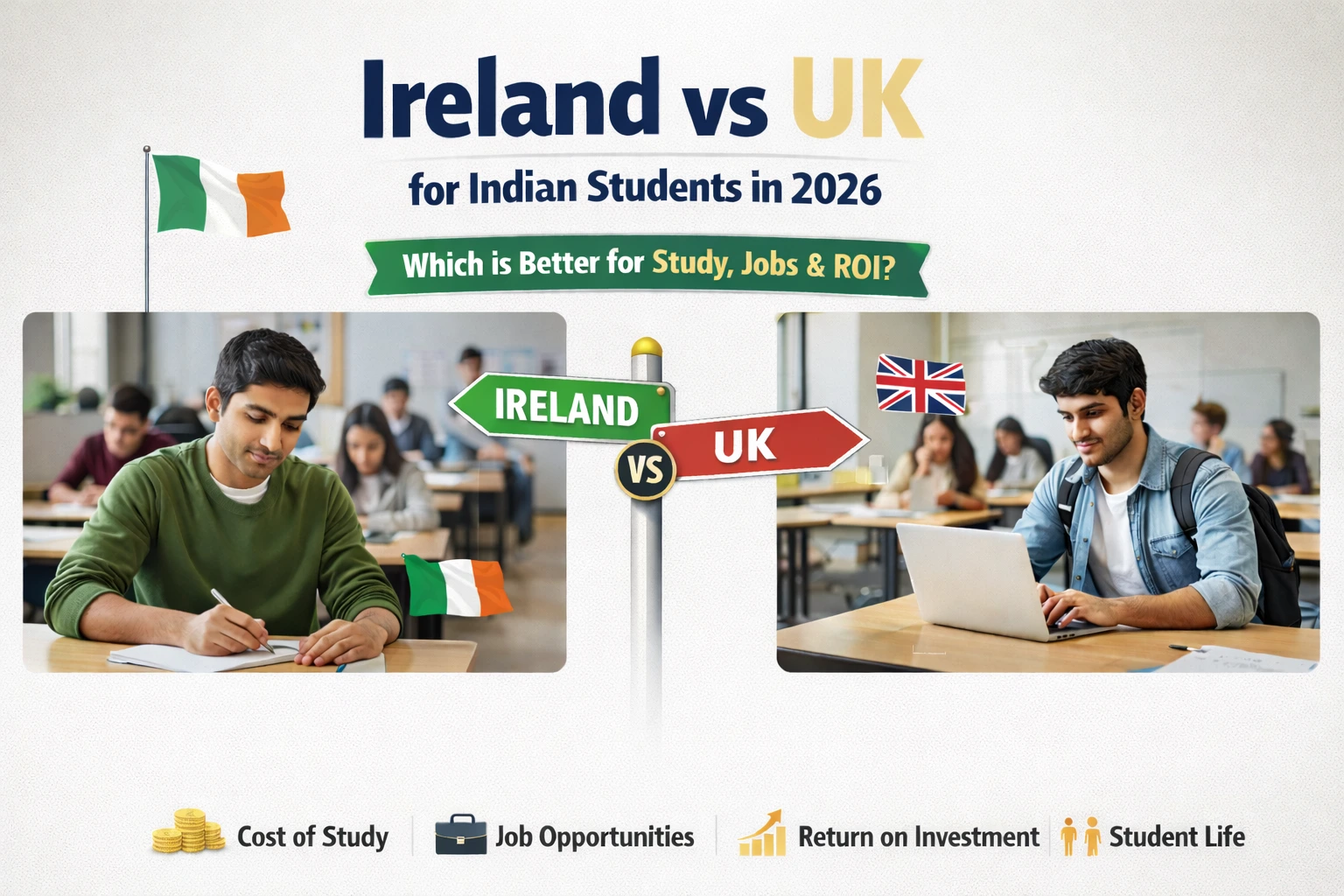
It depends on your goal. Ireland is strong for English-medium EU exposure and finance/tech ecosystems; the UK offers wider university choice and a larger Indian community. Choose based on ROI + career pathway + budget.
Can I work full-time after my Master’s?
Eligible graduates commonly use the post-study permission route (Stamp 1G) to work after completion. Exact conditions depend on your program level and current immigration rules.
Do I need to learn Irish (Gaelic)?
No. English is the primary language for universities, workplaces, and daily life.
What about PR / long-term settlement?
Ireland has long-term residence routes through work permits and legal residence over time. If citizenship becomes relevant later: Ireland may allow dual citizenship, but India generally does not—many Indians opt for OCI if they naturalize elsewhere. Always take legal advice and verify official rules at the time you plan.
Next Steps: What You Should Do Now
- Decide your goal: finance, fintech, data, MBA, analytics
- Shortlist 4–6 programs across 3–5 universities (mix of ambition + safety)
- Plan finances (tuition + living + visa funds + buffer)
- Build your SOP around a credible career narrative (role → skills → program → outcome)
- Start visa prep early using a structured checklist
Need help with applications or visas?
Talk to a Mentors Circle advisor for free guidance on courses, visas, and scholarships.
Free ConsultationRecent Posts
.webp)
University of Galway 2026: Admission Strategy, Career Outcomes , Real Answers — Live Webinar on 11 March
Ireland or UK? Best Study Abroad Choice for Indian Students in 2026 (Jobs, Cost & ROI)

Ireland vs Germany: The Ultimate Decision Guide for Indian Students Planning 2026 Intake
 Delegation Visiting Noida – Exclusive Student Interaction 28 February 2026.webp)