Quick Read
- Plan for 6–7 calendar weeks in 2026. Our live visa desk is currently running at ~45 calendar days from VFS appointment to decision, and recent Sep-2026 approvals landed between 40 and 56 days.
- The 2025–26 baseline was faster: a median of 24 working days (~34 calendar days), fast quartile 17 working days, slow quartile 31. 2026 is running roughly ten days slower than that baseline — build that into your plan.
- Best months to book VFS: April–May. Slowest: October–November — a swing of nearly four calendar weeks for the same application.
- When you can apply: visa offices generally accept study-visa applications from three months before your course start date. The Department of Foreign Affairs advises applying at least 8–12 weeks before travel.
- Applying for January 2027? Your real filing deadline is around 31 October 2026 — five weeks before the 4 December university deadline everyone quotes.
- VFS booking window: 7–31 calendar days from today — check yours with the tool below.
When you can — and should — lodge your application.
- Earliest: visa offices generally accept study-visa applications from three months before your course start date. For a 1 September start, that is roughly 1 June. A small number of offices accept earlier — confirm with the Irish Embassy or the VFS centre handling your file.
- Recommended latest: the Department of Foreign Affairs advises applying at least 8–12 weeks before your intended travel date. Study visas are explicitly listed as a category that can take longer at peak times.
- Do not book non-refundable flights until you have a decision in hand. This is standard advice from both the DFA and the universities.
Worked example, 1 September 2026 course start: application window opens around 1 June 2026; to have a decision comfortably in hand you want it lodged by mid-June at the latest, given the ~45-day turnaround we are seeing this year.
Two units on this page — here is how they line up. Our historical medians are in working days (Monday–Friday, excluding Indian and Irish bank holidays), because that is how a visa officer’s queue actually moves. Our live desk figures and the approvals list below are in calendar days, because that is how you count down to a flight. Conversion: 5 working days ≈ 1 calendar week; 21 working days ≈ 1 calendar month. So the 24-working-day median is about 34 calendar days. The live 2026 figure of ~45 calendar days is genuinely slower — not a different way of counting the same thing.
Every Indian family applying for an Ireland student visa wants the same thing: an honest answer to “how long will it take?” Immigration Service Delivery publishes a guideline of 4–8 calendar weeks — correct, but unhelpfully wide. Sixty calendar days is twice the wait of thirty.
So we published our own numbers instead. What follows is drawn from two sources: our tracked VFS-appointment-to-decision times across the Sep 2025 and Jan 2026 cohorts, and our live visa desk, which updates as each new embassy decision list is published. We have kept both on the page even though they disagree — because the disagreement is the story.
The headline numbers
Across the Sep 2025 and Jan 2026 cohorts, the median wait was 24 working days — about 34 calendar days, or five calendar weeks. The fast quartile came in at 17 working days (just over three calendar weeks) and the slow quartile at 31 working days (around six). A small number of outliers stretched to 53 working days; almost all of those were re-submission cases where the embassy requested additional documents, which restarts the assessment clock.
That was the baseline. 2026 is running slower. Our live desk figure below is the number to plan against right now:
Live from our visa desk
Ireland student visa decisions — the real numbers.
Source: visa decisions published by the Embassy of Ireland, New Delhi — compiled and analysed daily by The Mentors Circle visa desk. No personal data is used. For the month-by-month history, see our processing-time report.
Data window: 12 May 2026 – 21 Oct 2026 · Auto-updated 21 October 2026
Read the live figure, not the historical median. The ~45-calendar-day figure above is roughly ten days slower than the 2025–26 baseline of 34 calendar days. The recent approvals list further down shows the same thing from the other direction — those decisions landed between 40 and 56 days, with a middle value in the high forties. If you are applying for an intake in 2026 or 2027, plan for six to seven calendar weeks, not five. Anyone quoting you three weeks is quoting a best case, not a plan.
Why the slowdown? Two things we can see from our own files: application volumes from India have risen across every Irish intake since 2024, and the share of files pulled for additional documentation has grown with them. Neither is a reason to panic — the approval rate has held up — but both add days. The single biggest lever you control is not being one of the re-submission cases, which is a documentation problem, not a timing one. Our guide to funding evidence and our fee-payment strategy piece cover the two areas that trigger most document requests.
By VFS appointment month
The month you book your VFS slot matters as much as the paperwork inside it.
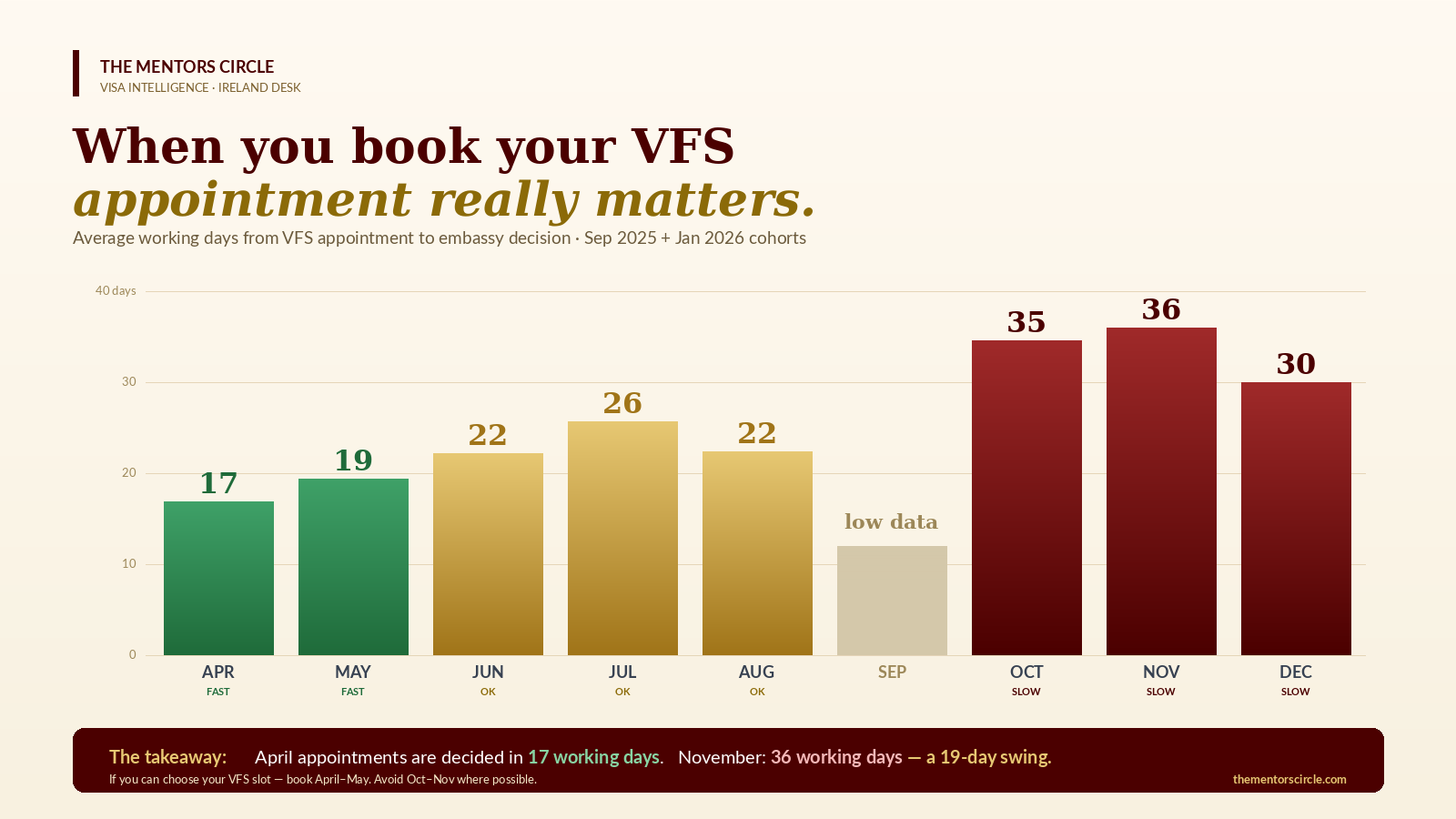
April against November is a 19 working-day swing for the same kind of application — nearly four extra calendar weeks. The cliff falls between August and October, when September-intake offer-holders all rush their slots at once and the visa-officer caseload spikes.
A note on what is missing: September carries too few tracked cases in our dataset to publish a reliable average, so we have left it unranked rather than print a number we cannot stand behind. January to March are similarly thin — very few Indian students file in that window, because it falls between the two Irish intakes. Where we have no data, we say so.
What this means if you're applying
For January 2027 intake — this is the live one
Almost every page on the internet tells you the deadline is 4 December 2026. That is the university's application deadline. It is not yours. Work backwards from a late-January start using the 45-day figure above and the real picture looks like this:
| Step | Realistic date |
|---|---|
| Course starts | late Jan / early Feb 2027 |
| Visa decision needed by | ~mid-January 2027 |
| Visa filed (45-day average) | ~1 November 2026 |
| AVATS submitted, VFS appointment booked | mid-October 2026 |
| Fee deposit paid, funds evidenced | early October 2026 |
| Offer in hand | late September / mid-October 2026 |
| University application submitted | now — August / September 2026 |
A student who applies on 3 December, one day inside the “deadline”, cannot start in January. The operative deadline is around 31 October. Book your VFS appointment between mid-September and end of October 2026; November bookings run straight into the slowest month in our dataset, and December bookings will not clear in time. Full details of which institutions are open and their individual cut-offs are in our January 2027 Ireland intake guide.
For September 2026 intake — the filing window has closed
If you are reading this in late August 2026 and have not yet filed for a September start, be realistic: at a 45-day average, a file lodged now returns a decision in October, well after orientation. Your options are:
- Ask your university for a deferral to January 2027. Most Irish institutions will move an offer between intakes on request, and this is by far the cleanest outcome. Then work to the timeline above.
- If you have already filed and are waiting, contact the university's international office now rather than after the start date — late arrival is usually accommodated if it is flagged in advance.
- Do not file a rushed application to chase the September date. An incomplete file that gets pulled for documents is slower than a complete one filed for January, and a refusal follows you.
If you are planning for September 2027 instead, applications open across most Irish institutions from 1 October 2026 — and our month-by-month intake action plan maps the same sequence you will follow a year on.
Fresh off the embassy list
Recent visa approvals.
| Student | Course | University | Intake | Decision in |
|---|---|---|---|---|
| ✓ Chirag Kumar | MBA | Dublin Business School | Sep 2026 | 51 Days |
| ✓ Vinay Dewangan | MBA | University College Dublin | Sep 2026 | 41 days |
| ✓ Ridhi Sharma | MSc Human Resources FT (B265) | University College Dublin | Sep 2026 | 47 days |
| ✓ Aditi Sharma | Pharmaceutical Sciences (M.Sc. / P.Grad. Dip.) | Trinity College Dublin | Sep 2026 | 46 days |
| ✓ Rishi Kapoor | MSc in Procurement and Supply Chain Management | Griffith College Dublin | Sep 2026 | 41 days |
| ✓ Sanil Badkul | MSc Management Consultancy FT (B261) | University College Dublin | Sep 2026 | 40 days |
| ✓ Rachit Birdi | Management & Marketing - MSc (non-EU applications only) (MSCMG) | University College Cork | Sep 2026 | 56 days |
| ✓ Arunima Gupta | MSc Information Systems FT (W267) | University College Dublin | Sep 2026 | 54 days |
| ✓ Honey Priyanka Karri | MSc in Business Analytics | Dublin City University | Sep 2026 | 56 days |
| ✓ Kanishka | Pharmaceutical Science (Msc) | Trinity College Dublin | Sep 2026 | 53 days |
| ✓ Himanshu Gupta | Master of Science in Artificial Intelligence | Dublin Business School | Sep 2026 | 47 days |
| ✓ Abel Subin | Corporate Finance (MSc) | University of Galway | Sep 2026 | 57 Days |
| ✓ Annyasha Biswas | Master of Science in Business Analytics for Decision Makers | National College of Ireland | Sep 2026 | 46 days |
| ✓ Preetish Kumar S A | MSc Computing (Artificial Intelligence) | Dublin City University | Sep 2026 | 46 days |
| ✓ Arijita Ganguly | Biomedical Science (MSc) | University of Galway | Sep 2026 | 49 Days |
| ✓ Param Dinesh Hingorani | Bachler of science in immersive software engineering programme 84483282 | University of Limerick | Sep 2026 | 49 days |
| ✓ Reeva Saraswat | Industrial Biotechnology and Biomanufacturing(MEngSc) | University College Cork | Sep 2026 | 49 days |
| ✓ Supriya | Master of Science in Artificial Intelligence | National College of Ireland | Sep 2026 | 36 days |
Every name is published with the student's written permission. “Decision in” is measured from the VFS appointment to the embassy decision.
These are real, recently completed TMC files, shown in calendar days from application to decision. They are the clearest available answer to “how long will it take?” — and the reason we tell students to plan for six to seven weeks rather than five. The list refreshes automatically as new embassy decision lists are published.
Check your appointment window
Different question, different unit. The processing-time data above is in working days and calendar days. The booking-window check below uses calendar days from today — you are picking real dates off a calendar, not visa-officer working days.
Our team recommends booking your VFS appointment between 7 and 31 calendar days from today. Less than 7 days and there is usually not enough time to complete documentation, tuition payment and loan disbursement. More than 31 days and your university deadlines start drifting out of alignment.
VFS Appointment Window Checker
Pick your planned VFS appointment date. We'll tell you whether it sits in the recommended window.
How we measured this
The historical medians come from our internal TMC visa decision tracker, covering Indian-resident first-time student visa applications for Ireland from the Sep 2025 and Jan 2026 cohorts. We measure working days (Monday–Friday, excluding Indian and Irish bank holidays) from the VFS appointment date to the embassy decision date, approval or refusal. Cases that needed re-submission for additional documents are included — that is why the slower months stretch beyond the median. Values were capped at 60 working days to filter out data-entry artefacts.
The live figures and the recent-approvals list are a separate, current dataset: completed 2026 TMC files, counted in calendar days from application to decision, refreshed automatically from published embassy decision lists. Where the two disagree, the live 2026 numbers are the ones to plan against — the historical medians are there to show you the direction of travel, which is slower.
To convert between the two: 5 working days ≈ 1 calendar week; 21 working days ≈ 1 calendar month.
Related reading
- January 2027 Intake in Ireland: Which Universities Are Open & How to Apply
- Ireland Intake Action Plan: A Month-by-Month Timeline
- Ireland Student Visa Fee & Payment Strategy 2026
- Education Loan vs Family Funds: Which Evidences Better?
- Ireland Pre-Departure Checklist 2026
- Working While Studying in Ireland: Stamp 2 Rules 2026
- Ireland vs UK vs New Zealand: Post-Study Work Visas Compared
- Study in Ireland: Fees, Visa & Universities — the full guide
Sources & further reading
- Immigration Service Delivery — Visa Decisions & Processing Times
- Department of Foreign Affairs — Visas for Ireland (application timing and 8–12 week guidance)
- Citizens Information — Visa requirements for entering Ireland
- VFS Global India — Ireland Visa Application Centre
- Education in Ireland — Pre-Arrival Information
Official guidance verified August 2026. Immigration rules and processing times change — confirm current details on the official sites before you apply. Note that Immigration Service Delivery (ISD) is the current name for the body formerly called INIS; older guides and forum posts still use the old name.
About The Mentors Circle. We have been guiding Indian families through Ireland student visa applications since 2014. We are an Enterprise Ireland endorsed agent with a 97% visa success rate, recently recognised by Ulster University for outstanding student advisory, and a long-standing partner of UCD, Trinity College Dublin, University of Galway, NCI, UCC and others. This dashboard updates after each completed intake, and the live blocks refresh with every new embassy decision list. If you are planning for January 2027 and want a clean, well-timed application, talk to a TMC counsellor.